



Glossary
& Links to Wikipedia© Entries on the Subject
ALTERNATING CURRENT (AC)
An electric current that reverses direction in a circuit at regular intervals.
External Link: http://en.wikipedia.org/wiki/Alternating_current (opens a new window)
ANSI -- American National Standards Institute
Used here to refer to standardized sizes for faceplates.
External Link: http://en.wikipedia.org/wiki/American_National_Standards_Institute(opens a new window)
CONTINUOUS DUTY
A device that is designed to operate continuously without rest.
CURRENT (Amps)
Measured flow of electrons through an electrical conductor. Normally measured in amperes.
External Link: http://en.wikipedia.org/wiki/Electric_current (opens a new window)
DIRECT CURRENT (DC)
An electric current flowing in one direction.
External Link: http://en.wikipedia.org/wiki/Direct_current (opens a new window)
DOOR HANDING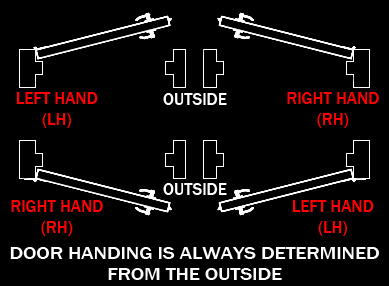 FAIL SAFE (RS) A device that is normally open and locks when power is applied to the unit. Often listed as �RS� External Link: http://en.wikipedia.org/wiki/Fail_safe (opens a new window) FAIL SECURE A device that is normally closed or locked until power is applied. Example: During a loss of power the device remains locked. FUSE A device that is placed in the path of energy that will break the circuit if the current becomes too great. This is accomplished by having a strip or metal that will melt when the current exceeds the required amount. External Link: http://en.wikipedia.org/wiki/Fuse_(electrical) (opens a new window) INTERMITTENT DUTY A device that is designed to operate for a short period of time; generally less that 45 seconds. LOCKSET TYPES 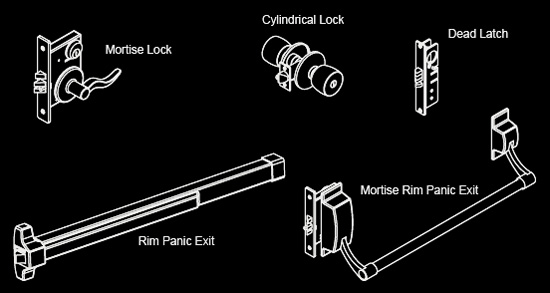 NORMALLY OPEN The contacts of a switch or relay are normally open or not connected. When activated the contacts close or become connected. EXAMPLE: A switch is not depressed and the circuit is not complete. NORMALLY CLOSED The contacts of a switch or relay are normally closed or connected. When activated the contacts open or become disconnected. EXAMPLE: A switch is not depressed and the circuit is complete. OHMS The measure of resistance of an electrical device to resist the flow of energy. See our Basic Electronics Page. PoE Friendly  A very low current draw device that can be used with PoE (Power over Ethernet) devices. PoE Friendly electric strikes use less then 300 Milliamps (.300 Amps) or around 3.6 - 3.7.Watts to activate. This provides plenty of "cushion" for PoE based access control systems, room to run longer wires, or extra amps to run additional devices. An electric strike of this variety does not come with an Ethernet port as a remote activation like that would rarely be used and not how such a devices is commonly used. See our Low Current Draw page for more! External Link: http://en.wikipedia.org/wiki/Power_over_Ethernet (opens a new window). RECTIFIER A device that is commonly used to convert AC to DC. Commonly used to silence the audible sound that an electrical strike can make while energized on AC current. External Link: http://en.wikipedia.org/wiki/Rectifier (opens a new window) RELAY An electro-magnetic device activated by a variation in conditions in one electric circuit and controlling a larger current or actuating other devices in the same or another electric circuit. External Link: http://en.wikipedia.org/wiki/Relay (opens a new window) STANDARD VOLTAGE 12 and 24 DC Voltage is standard -- Must specify when ordering strikes Most light commercial Electric door strike supplied with magnetic coils: 4-6VDC/8-16VAC. Electric door strikes supplied with a solenoid coil: 6-10VDC, 10-16VAC: other voltages available. TRANSFORMER A device consisting essentially of two or more coils of insulated wire that transfers alternating current by electro -magnetic induction from one winding to another at the same frequency, but usually with changed voltage & current. External Link: http://en.wikipedia.org/wiki/Transformer (opens a new window) VOLT A unit of electric potential equal to the difference of electric potential between two points that have a resistance of one ohm and through which a current of one amperes is flowing. See our Basic Electronics Page. VOLTAGE DROP? We recommend the following wire sizes:
WATT The power developed in a circuit by a current of one ampere flowing through a potential difference of one volt. (Watts = Amps x Volts) External Link: http://en.wikipedia.org/wiki/Watt (opens a new window) |
© 2025 by Trine Access Technology & trineonline.com. All Rights Reserved Privacy Policy | Terms of Use | Sitemap
Axion: Premium Electric Strikes® and Strikeline® are Registered Trademarks of Trine Access Technology. All rights reserved. |